Selected work
Brandon Martin
Marketing and growth leader. I build the system behind the work — and produce much of the work myself.

Seven pieces of work
Four years leading brand, creative and growth across six consumer brands, plus the products I've built myself. Each case notes whether the work was in-house or my own.
01
Taking a local institution national
The challenge
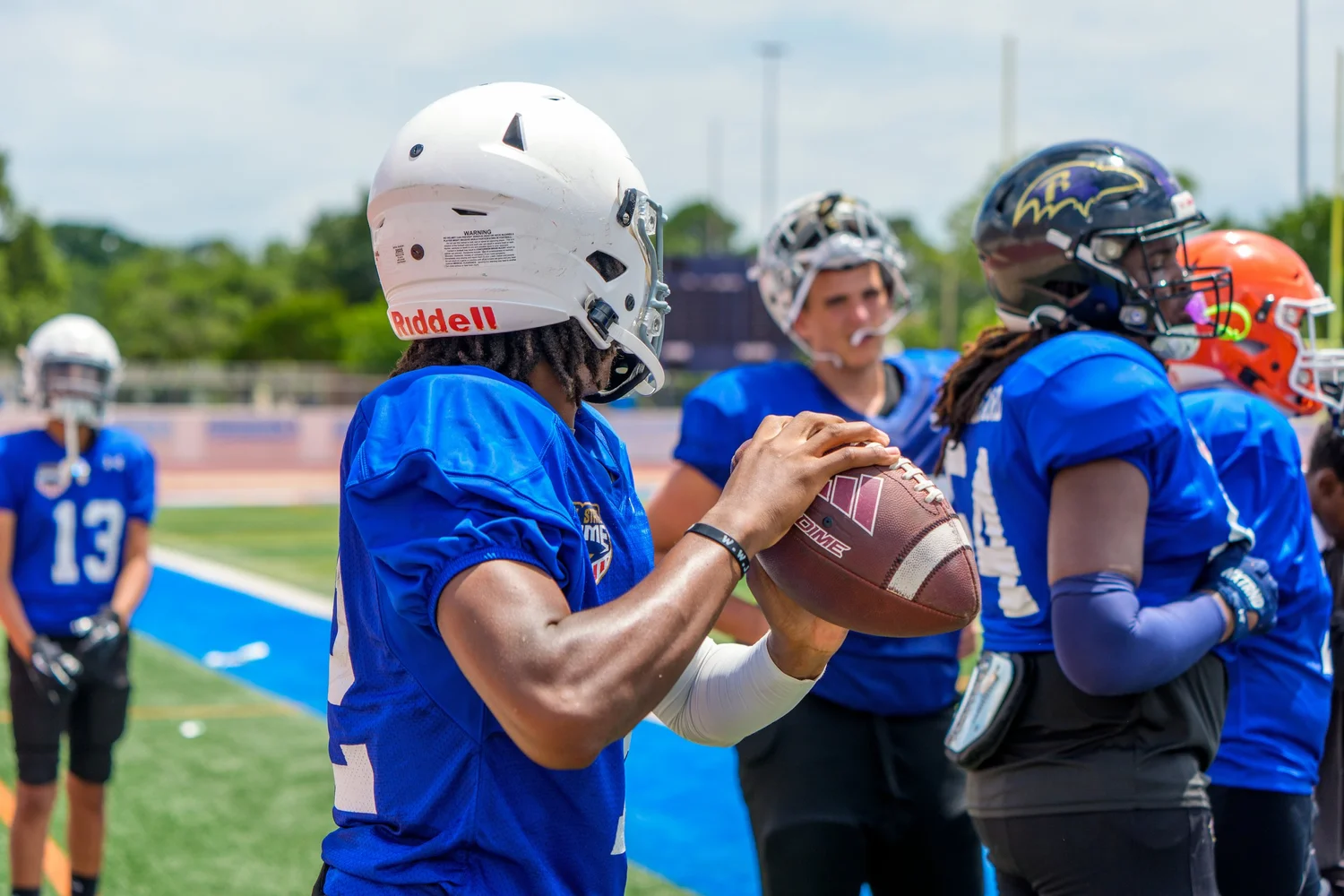
A single football event with 20 years of history in Idaho, newly acquired, with a mandate to take it national.
What I built
A coach-nomination network that gave the brand credibility in each new state, and the experience families remember: recognition packages, media days, game-day guides, and statewide livestreams with fan voting.
The result
Booked registration value grew from roughly $300,000 to about $1.6 million in three years, across four sports.
See the Game Day fan vote. Families voted during the game for Community Choice awards, and a leaderboard showed the athletes with the most votes.

02
Production systems for dozens of markets
The challenge
Live events in 16 markets a season, each needing its own materials, on a calendar that didn't move.
What I built
A template-driven production system: guides and posters produced for 20 state and sport events, 46 market-specific sponsor one-pagers, and event kits delivered press-ready to local teams.
The result
One kit — an intake form, 250 handouts, 50 coach cards and 10 certificates — went from brief to review-ready overnight. A consistent brand, local relevance, and a pace one team could sustain.

03
A record registration campaign
The challenge
Turning nominated athletes into registered travelers for programs in England, Spain and Italy.
What I built
Organic and paid media mapped to each campaign cycle, testimonial retargeting, nomination announcements recognizing 75 athletes per post, and live information sessions led by past coaches and staff.
The result
Close to 30% of nominated athletes registered, up from a record of 23%. Announcement posts drew 40,000–50,000 engagements each, and sessions produced registration spikes within 72 hours.
04
Making membership value visible
The challenge
A paid membership whose value was hard to see before joining, and harder to keep seeing after.
What I built
A homepage test previewing real scholarship opportunities; cohort analysis that located the retention problem in year two; and a member portal and rewards program built around what members were already doing.
The result
A 13–14% relative lift over control on the eligibility step, and about 2,480 members earning points.
05
A testing program that learned
The challenge
More ideas than testing capacity, and a need to know which changes actually moved results.
What I built
Weekly testing across pages, checkout and email, with success thresholds and holdouts set before launch, and every loss documented as carefully as every win.
The result
A 57% win rate across more than 55 documented tests. The clearest checkout win lifted conversion 18.8%.
What the program taught us
- Where proof sits decides whether it helps.
- Aspiration beats a list of features.
- Leading with a discount lost three times.
06
Innerfolk: idea to launch-ready in two weeks
The insight
Most people who start a journal stop, and the reason is rarely the writing: deciding what to write about is harder. Journaling apps are also built never to end, so there is no finish line. Innerfolk is the journal for the chapter you’re in: one question a day, chosen for what’s going on in a member’s life, and a year that finishes in a book.
What I built
- Brand. A system built on one rule: a dot means a day. Each member’s book cover is drawn from the days they actually wrote, in one of seven colorways.
- Product. A nine-section profile where every question has a rather-not-say, and nearly 1,000 questions across 14 chapters. Each morning’s question arrives with the reason it was chosen, and members can read anonymous answers to the same question.
- Privacy as the product. Entries are never read, sold, advertised against or used to train AI. Paid media runs on privacy-safe tracking, and results are judged by what Stripe records.
- Business model. $99 a year, or $249 with the printed book, billed on the web at about 3% instead of an app store’s 15 to 30%.
- Go-to-market. A gift-led Q4 plan on Meta, launching with twenty static ads, including a price A/B test, a gift Reel, and three brand-film series.
- Operating system. A Membership Performance OS: a weekly report, gates for scaling, and written rules for reinvestment and spend ceilings.
The result
Innerfolk launches in October 2026. Gifts are paid in full at purchase: at about $75 to acquire, each gift is modeled to contribute about $103 within the season, so the campaign can reinvest as it goes. Results will be added as they come in.


07
Making every place playable
The challenge
Getting people to explore real places through their phones, and giving local businesses a reason to take part.
What I built
A location-based AR platform: people capture and share AR photos and video, hunt for collectibles in city-wide scavenger hunts, and redeem them for rewards from local businesses. I helped build its technology and user experience.
The result
I'm a co-inventor on U.S. Patent No. 12,236,542, and we've run activations alongside Theatre Peckham and Mountview in London and MetaROC in Rochester, New York.
Before this
Film, television and branded content as a creative director, line producer and unit production manager at Genesius Studios, and earlier as a creative content lead at clarkmcdowall.
As a consultant from 2016 to 2022: HTC, Pepsi, TaylorMade, Samsung, Post-it and The Williamsburg Hotel.
Let's talk.
I'm glad to walk through any of this work — the thinking behind it, and the systems that made it repeatable.